comparison
Should our group meet in a library room, a bookstore back room or somebody living room?
Three venue types, three sets of rules. Compare meeting room policies, food restrictions, capacity, cost and how each one changes who actually shows up each month.
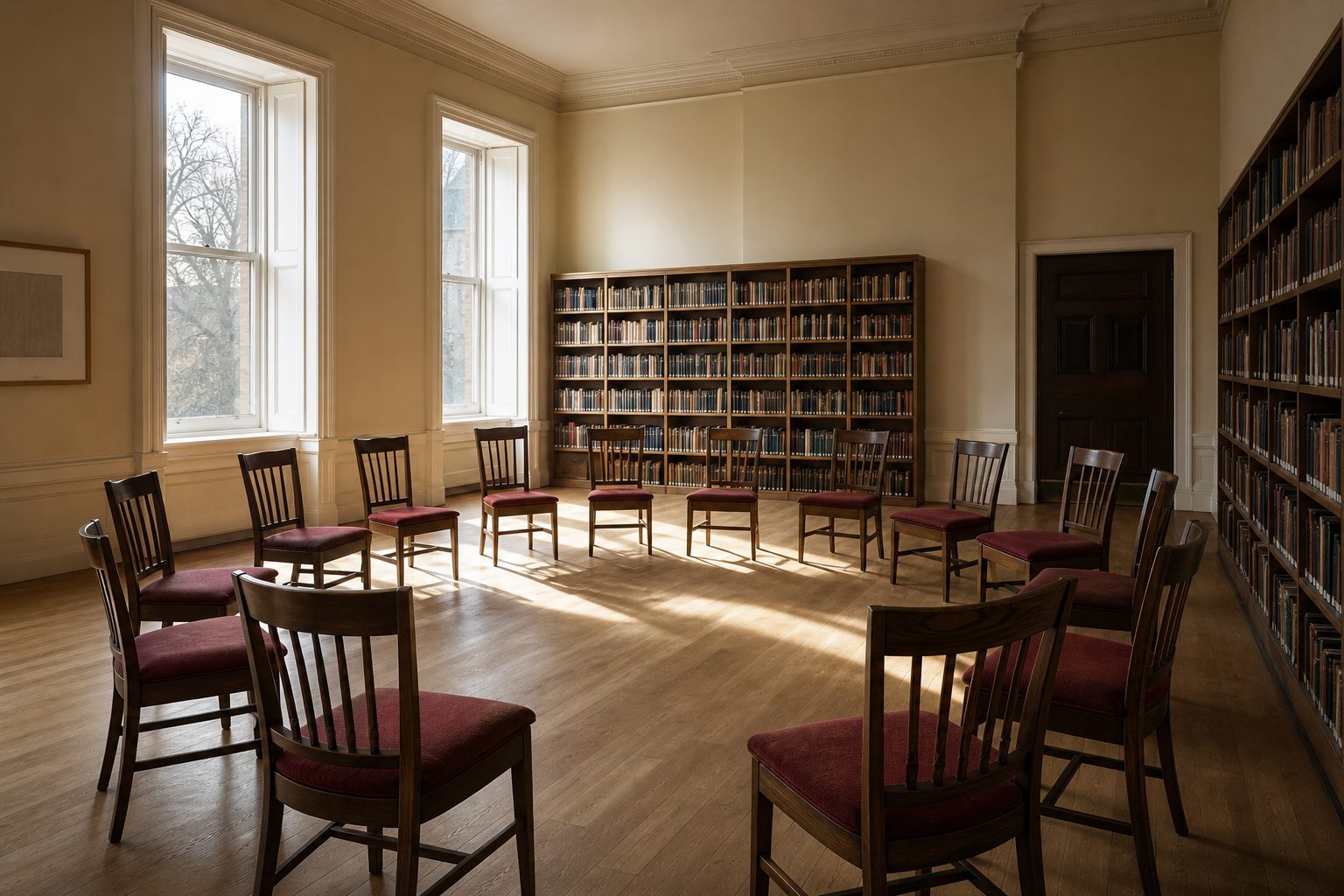
If you want steady attendance from people who are not already close friends, book the library room. It is free, it is neutral ground, it is accessible by law, and nobody has to vacuum. If your group is eight friends who like wine and a long night, rotate homes. The bookstore back room sits in between and works best when the group is genuinely willing to buy something.
That is the short answer, and most groups arrive at it eventually. But the reason it holds has less to do with atmosphere than with rules. Each venue comes with a policy set attached: reservation windows, time caps, food restrictions, capacity limits, and in the library's case a written no selling clause that catches groups off guard when an author wants to join.
Below is what each setting actually requires of you, what it costs when you count honestly, and the attendance pattern each one tends to produce over a year.
Library meeting rooms: reservation systems, time caps and the no selling rule
Public library meeting rooms in the United States are generally governed by a written meeting room policy adopted by the library board. That policy is a public document. Ask for it, or find it on the library's site, before you build a schedule around a room.
The provisions that matter to a book club:
- Reservation window. Commonly thirty to ninety days ahead, sometimes with a limit on how many bookings one group may hold at once. A monthly club on a ninety day window can hold roughly three meetings in the system at any time.
- Time cap. Two hours is typical, including your setup and cleanup. If your discussion runs ninety minutes, you have fifteen minutes on each end and no slack.
- Frequency cap. Some policies limit a single group to one or two bookings per month, which is fine for a monthly club and a problem if you split into two sections.
- No selling. Most policies prohibit commercial transactions, fundraising and admission fees on library property. That means a visiting author cannot sell and sign copies in the room unless the library itself arranges the sale through a partner.
- Library priority. Nearly every policy reserves the right to bump an outside group for library programming. It is rare, and it happens, usually with a week or two of notice.
Rooms are usually free for nonprofit or community use, occasionally with a refundable deposit or a modest fee for after hours access requiring staff. Ask about after hours specifically, because a room that is free at 6:30 pm may carry a staffing charge at 8:30 pm.
What the library gives you that the others cannot
Staff who can pull kit copies, a room address that is already on transit maps, parking that is designed for the building's capacity, and a neutral space where a member who does not want colleagues in her home, or does not want to be in a stranger's home, can attend without explaining herself.
Keep reading: What are the rules on showing a movie adaptation at our library book club meeting?
Bookstore back rooms and the unspoken expectation to buy
Independent bookstores host clubs for a straightforward reason: readers in the store buy books. The room is rarely rented in the formal sense. The arrangement is usually a handshake with an events coordinator, and the currency is sales.
Understand the deal you are actually making. If your group reads library kit copies exclusively and orders nothing, the invitation quietly dries up within a few months. If members buy the monthly title at the store, often at a small discount for club members, the store has a reason to keep the room open on the third Tuesday indefinitely.
Practical realities to check before committing:
- Whether the store is open during your meeting, and whether the space is enclosed or a corner of the sales floor with browsers walking through
- The real capacity, which in most back rooms is ten to twenty chairs
- Whether coffee or wine service exists, and whether outside food is allowed
- Whether the store will special order the title for the group and hold copies under the club name
- Whether the store expects the club listed on its public events calendar, which brings strangers and changes the group's character
That last point deserves a decision, not a drift. A store listed club is a public program. If your members joined expecting the same twelve faces, say so up front.
Homes and host rotation: parking, accessibility and the cleanup tax
Homes produce the warmest discussion and the highest hidden cost. The cost lands on one person per month, unevenly, and it is the leading reason a rotation collapses back onto whoever is least able to say no.
The cleanup tax is real work: two to three hours of tidying before, food and drink preparation, an hour of dishes and reset after. Attach a dollar figure to it and the picture sharpens. At a self assessed value of twenty dollars per hour for five hours of labor, that is one hundred dollars of unpaid effort before anyone has bought a cheese board.
Then the constraints nobody announces:
- Street parking that fits four cars when nine people are coming
- A walk up unit with no elevator, which silently excludes any member with mobility limits
- Pets and allergies, which one member will not mention and will simply stop attending over
- Children and household schedules that make a 7:00 pm start impossible in some homes and mandatory in others
A rotation works when it is written down a season ahead, when the host's only obligation is the space plus one simple thing to drink, and when members who cannot host for any reason opt out permanently without a conversation about it.
Keep reading: Why does attendance collapse in the fourth month and how do other hosts fix it?
Cost per meeting compared honestly across the three
Money is not the deciding factor, but it should be visible. This table uses a twelve person group, one meeting per month, and assumes the figures below are illustrative planning estimates rather than quoted prices.
| Line item | Library room | Bookstore room | Rotating homes |
|---|---|---|---|
| Room fee | $0 | $0 | $0 |
| Expected purchase per member | $0 | $18 monthly title | $0 |
| Host food and drink | $0 | $5 optional coffee | $45 to $80 |
| Host labor, 5 hours at $20 | $0 | $0 | $100 |
| Group cost per meeting | $0 | $216 in book sales | $145 to $180 on one person |
| Cost falls on | Nobody | Each member equally | One member, rotating |
The bottom row is the useful one. The bookstore is the most expensive option in total dollars and the fairest in distribution. The home is cheaper in total and lands entirely on one person, which is why it feels free to eleven people and heavy to one.
Accessibility and ADA expectations in each setting
Public libraries are government facilities and are covered by Title II of the Americans with Disabilities Act. Retail bookstores are places of public accommodation covered by Title III. Both are expected to provide accessible entrances, routes and restrooms, with older buildings subject to the standards that applied at the time of construction or alteration. A private residence is covered by neither.
What this means at ground level:
- A library room will have a level or ramped entrance, an accessible restroom, and designated parking. Ask about assistive listening if a member has requested it, since many libraries have a system available.
- A bookstore should have an accessible entrance and route to the meeting area. Older storefronts with a single step are common, so look rather than assume.
- A home has whatever it has. If a member uses a wheelchair or cannot manage stairs, home rotation limits you to the subset of homes that work, and you must know which those are before you publish the schedule.
Handle this by asking every member once, in writing, at signup: is there anything about a venue that would keep you from attending. Then keep the answers and check the rotation against them.
See how BookClubRoster handles this for book clubs and reading programs
Food, wine and what each venue will and will not allow
This is where policies differ most sharply, and where hosts get embarrassed in front of a room.
| Venue | Food | Alcohol | Cleanup expectation |
|---|---|---|---|
| Library room | Often light refreshments allowed, sometimes prohibited entirely near collections | Usually prohibited, occasionally permitted by written permission for library sponsored events | Room restored to original setup, trash removed by your group |
| Bookstore | Store cafe items usually fine, outside food varies | Only if the store holds the relevant state license | Chairs restacked, area left clear |
| Home | Anything | Anything legal | Falls on the host |
The library alcohol question is worth asking directly rather than assuming, because policies vary by system and a few permit it for specific programs. Do not bring wine to a library room on the theory that nobody will mind.
Attendance patterns each venue tends to produce
Venue shapes who comes, in ways that are consistent enough to plan around.
Library rooms tend to produce stable, slightly larger turnout with weaker social bonding. The fixed end time cuts the discussion off cleanly, which some members love and others find abrupt. Newcomers join more readily, because walking into a public building is low risk.
Bookstores draw the most enthusiastic readers and the least reliable attendance, especially if the meeting is publicly listed. Expect a wider spread month to month.
Homes produce the highest loyalty among people who already attend and the highest barrier for anyone new. Turnout is steady until the host rotation strains, and then it drops fast.
A pattern that works well: library room for eight or nine months of the year, homes for the holiday meeting and one summer evening, bookstore when an author is touring and the store can host properly.
Deciding, then keeping everyone informed
Run this in order. Poll members on access needs and preferred night. Read your library's meeting room policy and confirm the reservation window. Price the home rotation honestly, including labor. Then pick a primary venue for the year and name your exceptions.
Whatever you choose, the venue only works if the group knows where to be and you know how many are coming. BookClubRoster keeps the RSVP count, the host rotation and the location for each meeting in one shared place, so the person opening the library room knows to expect fourteen and the host in December is not finding out on the day. Set the year's schedule once and let the reminders do the chasing.
Run the next meeting from one page
BookClubRoster keeps the ballot, the RSVP list, the host rotation and the discussion guide for every title in one place your members can open without a password.